
撕裂人
When a Chinese mythic world travels without translation_我的网站

A | 00后大学生网络行为呈现圈层化、娱乐化、碎片化特征,而传统思政话语面临表达生硬、传播低效、供需错位等困境。本研究立足省高校辅导员一线视角,基于6所本科院校874份有效问卷及日常观察数据,梳理大学生网络行为画像,剖析思政话语短板,提出创新策略与传播路径优化建议。 调研基础:省高校大学生网络行为画像数据与群体特征调研覆盖大一至大四学生,数据显示:日均上网时长3.41小时,26.3%日均上网超4小时;休闲娱乐占上网总时长79.5%,专业学习与时政浏览仅占20.5%。

There was no narration explaining the mythology behind palaces rising above an ocean of clouds in the video, nor subtitles identifying the heavenly gates, cranes or tiny figures moving beneath them.
Yet viewers outside China quickly began naming the world for themselves.
Some called it "paradise." Others saw a "Celestial Palace" or an "Immortal Realm" familiar from Chinese fantasy games and television dramas. One user wrote, "Waiting on Wukong to show up," invoking the Monkey King from the Chinese literary classic "Journey to the West," or the hit game "Black Myth: Wukong."
The interpretations differed, but viewers did not seem to need the same cultural knowledge to enter the conversation.
Earlier this month, Chinese foreign ministry spokesperson Mao Ning shared the 33-second AI-generated video on social media with a question: "What does the Chinese heaven look like?"
It opened up a hermeneutic discussion, with responses overseas suggesting a cultural image does not necessarily need to elicit exactly the same interpretation for everyone in order for it to be viewed meaningfully.
"The right to interpret ultimately lies with the audience," said Zhang Zheng, deputy dean of Tsinghua University's School of Journalism and Communication.
People encountering unfamiliar cultures inevitably draw on what they already know, Zhang said. Rather than fully grasping every cultural reference, what matters is whether audiences can encounter the work, understand it and respond to it emotionally.
Before strangers abroad could interpret this particular world, however, it first had to get out of one man's head.
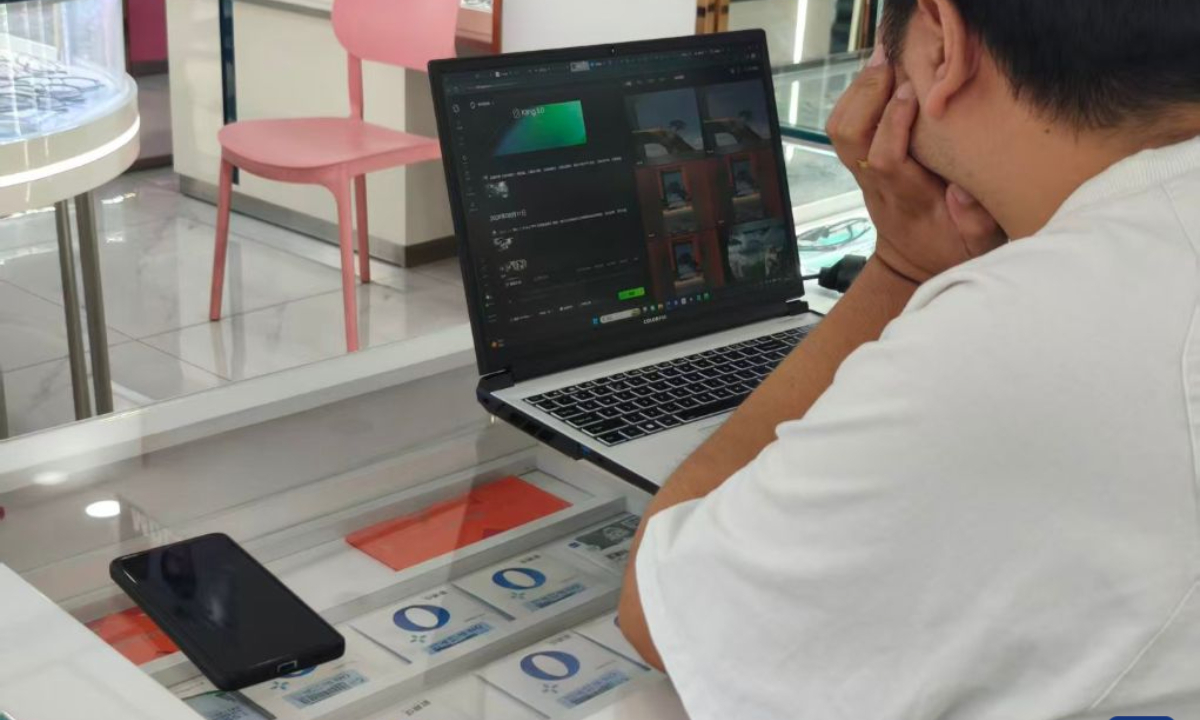
Chen Aijun, 34, is an optometrist in Chengdu, capital of southwest China's Sichuan Province.
By day, Chen leads a quiet, down-to-earth life in a neighborhood optical shop. Inside, he worked among eyeglass frames and optometry equipment. On his computer was another landscape entirely: cloud seas, immense palaces, flying cranes and figures in ancient robes.
Chen's heaven did not come from any single ancient text.
Growing up in the 1990s, he watched "Journey to the West" and later encountered "The Investiture of the Gods," xianxia (immortal heroes) novels and fantasy games. Those stories mixed over time with images of Chinese architecture and landscapes he saw online.
He has never visited nearby Mount Emei, and most of what he knows of Mount Huangshan's famous sea of clouds comes from videos.
What appeared on his screen was therefore not a reconstruction of one fixed mythological scene, but a world shaped by traditional stories already filtered through television, novels, games, the internet and his own memory.
For years, Chen had no way to make that world visible.
He never studied painting, design, photography or 3D modeling. After high school, he joined his parents' optical business and eventually took over the shop.
Generative AI changed the gap between imagining an image and possessing the technical skills to show it to someone else.
More than a year ago, Chen began teaching himself through free online tutorials. In September 2025, he started regularly posting AI videos, and a month later began experimenting with palaces floating above clouds. He has since published more than 200 videos.
The process, however, involves far more than entering a few prompts. The technology lowered the technical threshold, but it did not make the choices for him.
When creating Nantianmen, the mythical heavenly gate, Chen first defines the spatial rhythm and tonal hierarchy, pairing towering architecture and cloud seas with deliberately miniature figures to amplify the celestial realm's grand scale.
If the result does not match the picture in his mind, he tries again. He often generates over 1,000 images a day, revising a single scene repeatedly before moving on to animation, editing, color grading and music.
The machine can generate a thousand possible heavens. Chen still has to decide which one is his.
"AI-produced images can be soulless, and it takes human inspiration and aesthetic sensibility to endow works with warmth and vitality," he said.
Zhang believes Chen's experience reflects a broader shift brought about by generative AI. He said AI is giving people without conventional artistic training access to forms of expression that once required specialized skills. But what they create still depends on what they bring to the tool.
"A person's existing knowledge inevitably shapes how they use AI," Zhang said.
Chen brought his memories to the machine. Viewers abroad, in turn, brought theirs to the image.
"Everyone brings their own associations to these scenes," he said.
If his imagined world had to be reduced to three elements, he would keep clouds, architecture and people. The first two should feel immense, he said, while the last should remain small.
The details are culturally specific, but the visual effect is more immediate: tiny human figures dwarfed by vast clouds and monumental architecture. The responses suggest that viewers did not need to understand every cultural reference to find a way into the image.
Chen has no overseas social media accounts and learned that the video was attracting attention abroad only when friends sent him screenshots.
His life at the optical shop has changed little. He still checks eyesight and fits glasses when customers come in, then returns to his computer when the shop grows quiet.
He now hopes to make longer AI videos with fuller stories. He also wants to visit Mount Emei and, one day, Mount Huangshan.
For years, images of distant mountains and clouds reached Chen through screens. His imagined landscapes later traveled through screens to people he had never met.
Now he wants to see the real mountains and clouds for himself.
。平台方面,抖音、快手渗透率96.8%,微信、QQ为社交核心,知乎、小红书兴趣圈层活跃度62.4%。信息辨别层面,47.8%遇热点不核实信息来源,72.1%更信短视频博主或同龄网友。聚类分析划分四类画像:娱乐流量型,以短视频、游戏、追星为主,抵触长篇理论,最难触达;求知务实型,偏好知乎、B站获取技能与政策信息,愿读简洁干货,为重点培育群体;情绪敏感型,频繁倾诉学业、人际、就业焦虑,易被负面情绪裹挟,需情感疏导;传统正向型,主动参与时政与校园思政活动,可发展为朋辈意见领袖。

B | 依托网络行为画像创新高校思政工作话语体系一是分层打造适配话语。面向娱乐流量型,以短视频、情景剧拆解理论,化宏大叙事为日常故事;面向求知务实型,围绕考研、就业推出问答式、解读式干货;面向情绪敏感型,以倾听、陪伴语态开设线上树洞,柔性引导学业与人际困扰;面向正向型,搭建朋辈引领平台,鼓励学生原创内容。二是融合本土资源打造在地化话语。

C | 深挖太行精神、西柏坡文化及优秀毕业生事迹,用“身边人、身边事”叙事,将家国情怀落脚于返乡就业、志愿服务等真实场景,增强地域温度与现实质感。

D | 同时,辅导员常态化扎根班级群与兴趣社群,48小时内回应学生思想困惑,变“说教管控”为“平等交流”,并规范底线,抵制低俗化过度解构。基于网络画像的思政话语立体化传播路径一是搭建差异化矩阵。短视频阵地以辅导员个人视频号、班级账号为载体,每周推出短剧、红色科普;社群阵地依托班级群、兴趣群,每日分享轻量化内容并开展话题讨论,对情绪敏感学生私聊引导。二是推动线上与线下双向闭环。线上发布研学、志愿服务预告,学生参与后分享实践成果,辅导员二次传播,形成“线上发起、线下体验、线上扩散”循环。

E | 三是培育辅导员与学生朋辈协同队伍。辅导员每周至少3次深入学生网络社群,提升话语转化能力;选拔正向型学生担任朋辈宣传员,覆盖游戏、考研等圈层。数字化时代,网络行为画像为精准思政提供科学依据。面对青年圈层化、多元化特征,高校须以数据驱动话语重构,打造兼具青年亲和力与本土特色的创新体系,依托分层、立体、双向的传播路径,切实提升网络育人实效。(作者 科技大学王雪松、肖云川 本文系2026年省高校思想政治工作研究课题《基于大学生网络行为画像的高校思想政治工作话语体系创新及传播路径研究》课题编号:HBSZKT-2026044)研究成果。
Current article:http://6n91ve9.senchuoshaozaodidia.shop/list_r4sv8kc/7sqsq4.html
Published on:01:06:33
 Saira Banu Pays a Tribute to Dilip Kumar on His Birth Anniversary
 Delhi High Court closes all proceedings against Delhi Health Minister Satyendar Jain under amended benami law
 消息称,LGV20和G5将不再接收Android更新和安全补丁。
 SC: ED challenges bail granted to ex-Maha HM Deshmukh
 Vrusshabha Trailer Unveiled, Mohanlal Steps Into an Epic Tale of Legacy and Rebirth
 Rivian聘请前Waymo高管负责新自动驾驶和人工智能业务
- ·一场脱口秀带火这只股!开盘一字涨停!公司紧急回应!_脱口秀演员回应带火股票“600759”_一场脱口秀带火一支股票?公司回应
- ·8月1日至21日巴西大豆出口量为688万吨
- ·联通产业经济廊道,跑出协同发展“加速度”
- ·火箭媒体人:乌度卡会在录像分析课上让失误过多的球员担责
- ·India logs 2,119 new covid cases in 24 hours
- ·追梦:火箭几次缩小分差 我们把球交给巴特勒&他总能平息对手进攻
- ·EA取消了星球大战在开放世界中的游戏开发
- ·新款比亚迪海豹07 DM-i申报图 引入激光雷达 前脸更耐看了
- ·苹果iPhone18系列已量产
- ·The world’s largest impulse hydropower generator completes rotor hoisting in Southwest China’s Xizang
- ·Philippine military ordered to stop using AI apps due to security risks
- ·大力优化营商环境 加快高质量发展|廊坊原产地证书“秒审秒签” 政策红利直达企业
- ·索尼XZ4英俊的渲染曝光:全球首部21:9全屏
- ·施罗德谈76人群星:很好奇他们该如何完成磨合
- ·“제정신이야?” 현직 경찰이 전 연인 집 주소 알려줘…‘보복 대행’ 맡긴 30대
- ·不给糖就捣乱 任天堂免费提供2022万圣节特别壁纸
- ·36.1万“法律明白人”活跃在基层
- ·日本媒体:苹果将削减三款新iPhone生产量的10%
- ·Editor's Take: Why Priyadarshan Needs to Be Celebrated More?
- ·魔兽争霸3:复制打开官方网站预约:经典作品,回归国王
- ·全新宝马X7预计2027年8月投产 将保留柴油版 暂无插混车型计划
- ·国债期货走弱30年期主力合约跌0.2%
- ·政声直达|河北拿出“真金白银”助力稳就业
- ·福建提升防汛应急响应为三级
- ·国台办:民进党当局鼓噪“抵御统战” 完全站在台湾民众对立面
- ·从“四个构建” 了解湖南田长制有何特点丨全面推行田长制新闻发布会_体系_耕地
- ·特斯拉电话会看点:今年交付量增速可能略低于50% 经济衰退也不会减产
- ·Germany's Foreign Office warns citizens against traveling to Iran
- ·让AI长出Office 金山办公“灵犀”智能体不止于对话
- ·Florida law targeting drag shows can't be enforced for now, appellate court says
- ·西工大入选全国首批国家级创新创业教育实践基地建设单位_教育部办公厅_大学
- ·白晶谈百分大战输小卡:他像铁块一样硬 我像邢道荣被关羽斩落